Best for: beginners, makers on a budget, brands wanting natural positioning.
Soy is popular for good reasons: affordable, widely available, slow-burning, and strongly associated with "natural" candles in consumer marketing, which has commercial value whether or not it's strictly accurate. The trade-offs: soy is prone to frosting, sinkholes, and wet spots. These are aesthetic rather than performance issues, but they matter for a product that's supposed to look premium. Soy holds fragrance at 6% to 10%; hot throw is moderate and cold throw tends to be subtle.
Best for: premium positioning, strong cold throw, a smooth clean finish.
More expensive than soy but significantly easier to work with aesthetically: it cures with a naturally smooth, creamy surface that looks expensive without much effort. Cold throw is noticeably stronger than soy at equivalent loads; hot throw is steady and even. The lower melt point makes it sensitive to warm temperatures in transit, and its softness makes wick selection important. Holds fragrance up to 10% to 12%.
Best for: premium performance, consistent results, strong cold and hot throw.
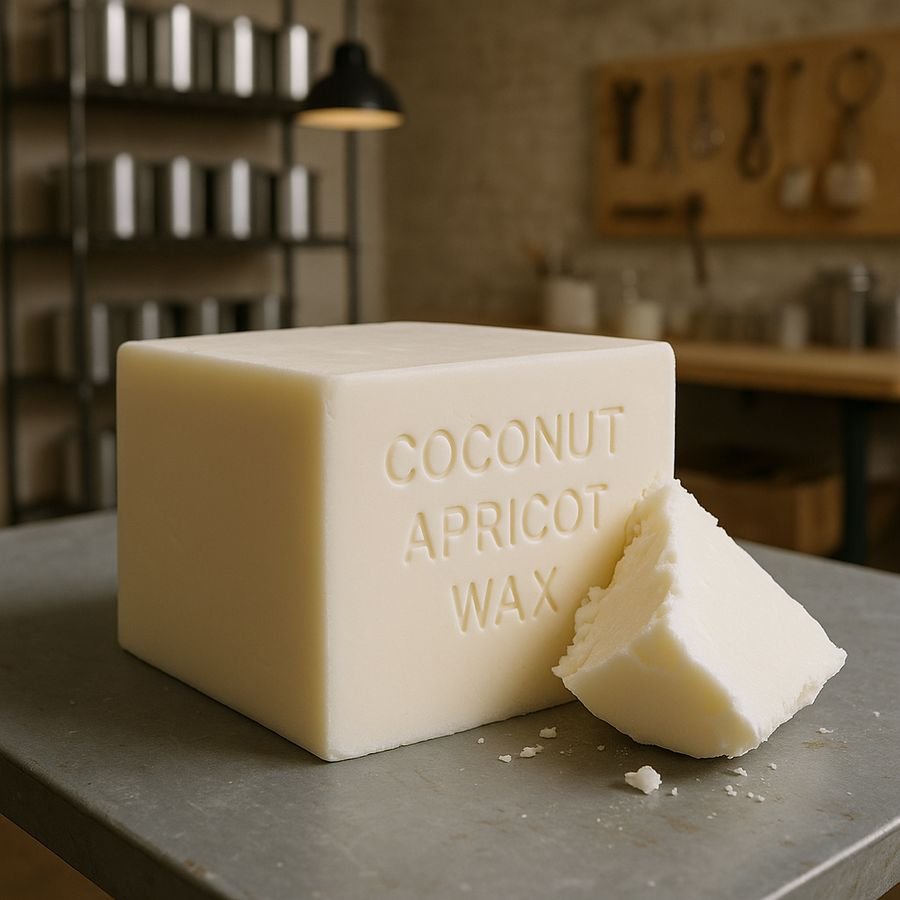
This is the wax that earned its place as a genuine favorite among serious makers. Apricot kernel wax gives coconut a structural backbone without compromising its elegance: better jar adhesion, smoother tops, stronger cold throw, and a hot throw that fills a room without overwhelming it. Slightly more expensive than straight soy, but the performance difference justifies it at almost any price point above $18. They cure consistently, resist frosting, and photograph beautifully. Most blends in this category hold fragrance reliably at 9% to 10%.
Best for: maximum scent throw, consistent performance.
Paraffin gets a bad reputation in wellness-adjacent marketing, but the truth is more nuanced. It's a petroleum derivative, and it's also the wax used by many of the most respected candle brands in the world, including some positioned as premium or artisanal. It burns hotter than plant waxes and throws fragrance aggressively. The trade-off is soot when wicked incorrectly or burned untrimmed; proper wicking and maintenance largely eliminates it. The "non-toxic" argument against paraffin is largely overstated: all waxes produce some byproducts when burned, and the levels from properly formulated, correctly burned paraffin candles are not considered a health risk by major regulatory bodies. Make material decisions on data and brand values, not marketing noise.
Best for: ambiance, long burn time, natural honey scent, pillars.
The oldest candle wax there is. It burns longer and slower than any common wax, produces warm golden light, and carries a natural honey-amber scent. It's significantly more expensive per pound and holds fragrance at only 3% to 6%, with its own scent competing against added fragrance. Excellent for unscented or lightly scented candles where ambiance is the point.
Many experienced makers end up blending waxes to balance properties: soy-paraffin for slow burn plus throw, coconut-beeswax for fragrance capacity plus burn time. Blending adds complexity, and every new combination needs independent testing. Don't blend until you understand each wax individually.
Starting out: coconut apricot or a quality soy blend. Forgiving, good-looking, reliable fragrance capacity, and a legitimate premium story without overclaiming. Scaling with cost pressure: soy blends for higher-volume SKUs, coconut apricot for the premium line. If throw is your primary selling point: consider paraffin or a paraffin blend and invest in proper wick testing.
Use the wax conversion calculator to convert weights for any wax type and the fragrance load calculator to dial in ratios once you've chosen. The full breakdown of wax selection, and how it connects to vessels, wicks, and brand positioning, is in the Six Figure Wick ebook.
Keep reading: browse all guides, or put the numbers to work in the free calculators.
Sign up and receive our free candle pricing cheat sheet, plus one useful note from the studio each week. Unsubscribe anytime.