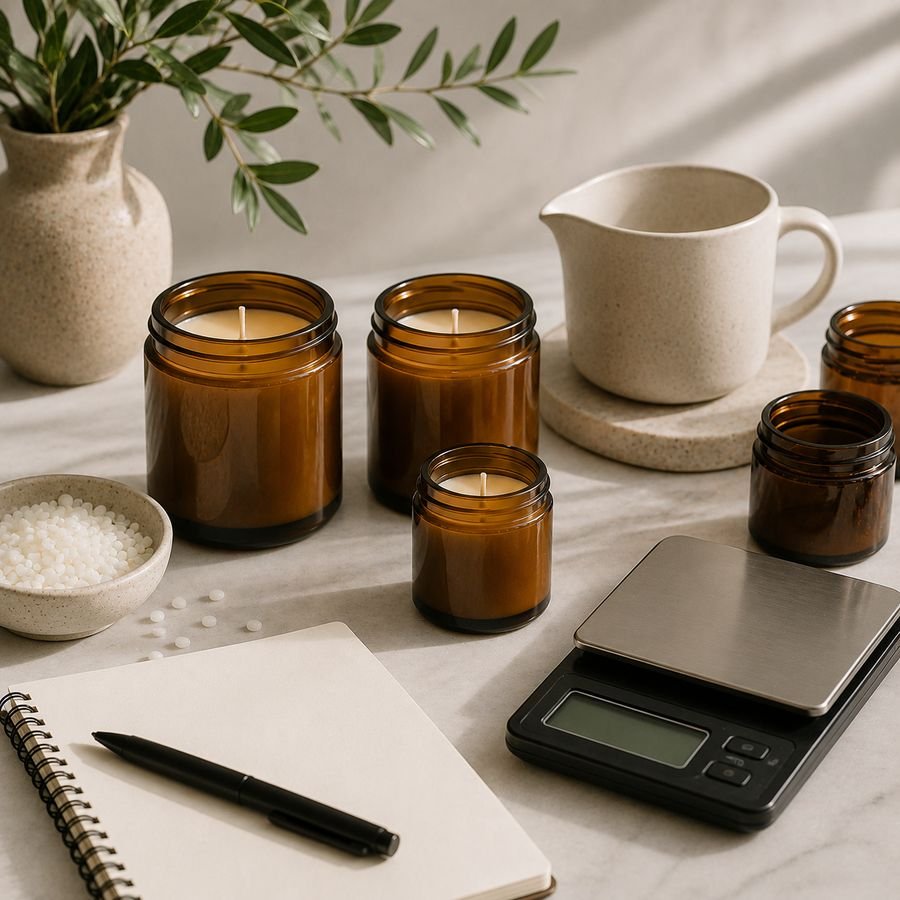
Choosing the right amount of wax for your candle jar is one of the most important steps in candle making. Too much wax and your candle may overflow or burn improperly. Too little and your jar looks half-filled and unprofessional.
Accurate wax measurement affects candle appearance, burn performance, fragrance distribution, and cost control. Many beginners guess wax amounts, which leads to wasted materials or poor-quality candles.
Candle jars are measured in milliliters, ounces, or grams; most makers use grams for accuracy. Important: wax weight is not the same as jar volume, because different wax types have different densities.
Wax weight ≈ 0.85 × jar volume for most waxes, because wax expands and shrinks depending on fragrance oil and density.
Example: 200 ml.
200 ml × 0.85 = 170g wax (approximate for soy and paraffin blends).
At a 10% load: 17g fragrance oil, so 153g wax.
Final result: 153g wax + 17g fragrance oil = 170g candle.
Soy is softer and needs slightly less wax per jar. Paraffin is denser, holds fragrance well, and burns slightly more efficiently. Coconut wax is creamy and often blended with other waxes. Always test your blend before scaling production.
Manual calculation works, but scaling gets complex. The jar fill calculator converts your vessel's water capacity to exact wax and fragrance amounts in seconds, and the wax conversion calculator handles unit conversions for any wax type.
Measure jar volume in ml and multiply by 0.85 to estimate wax weight.
Wax shrinkage or incorrect pouring temperature.
Always by weight (grams) for accuracy.
Yes, fragrance oil replaces part of the wax in total candle weight.
Keep reading: browse all guides, or put the numbers to work in the free calculators.
Sign up and receive our free candle pricing cheat sheet, plus one useful note from the studio each week. Unsubscribe anytime.